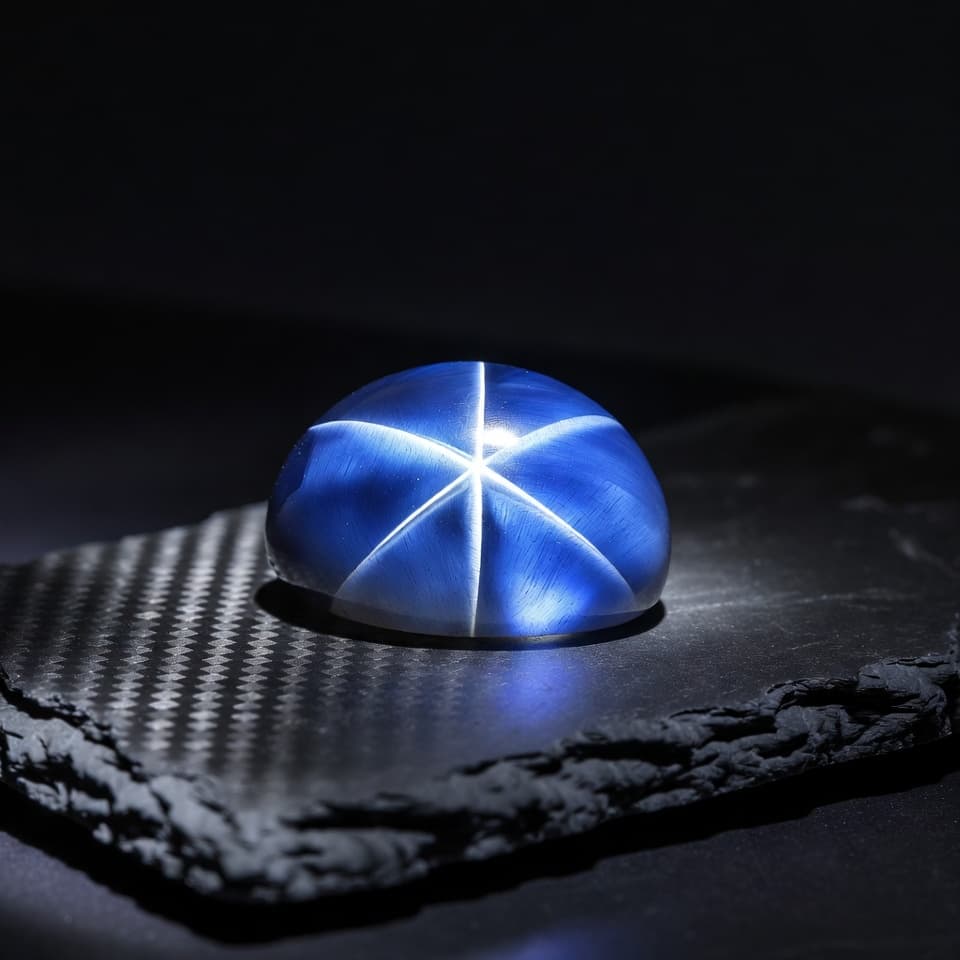
A star sapphire is a sapphire that shows a moving star of light across its dome, an effect called asterism. The star is caused by light reflecting from vast numbers of microscopic needle-like inclusions, aligned by the crystal structure itself. Sri Lanka is one of the classical sources for the effect.
Asterism is the one case in gemmology where inclusions are the point. In a faceted sapphire, inclusions are tolerated. In a star sapphire they are the entire reason the stone exists, and the skill lies in cutting to reveal them.
What causes the star
Corundum frequently contains fine needles of rutile, known in the trade as silk. Because the host crystal is hexagonal, those needles grow in three directions set sixty degrees apart. Light striking the dome reflects from each set of needles as a band, and the three bands cross to produce a six-rayed star. The star is not painted on or fixed in place: it is a reflection, so it moves as the stone or the light moves.
Why it must be a cabochon
Asterism only appears when the stone is cut with a smooth dome, and the dome must be oriented correctly relative to the crystal axis. Facets would break the continuous reflection into fragments. This is why every star sapphire is a cabochon, and why the orientation decision made at the cutting wheel determines whether the star sits centred on the dome or slips off to one side.
A star sapphire is judged first on the star, then on the colour, and only then on the transparency.
What separates a fine star from a weak one
- Centring. The star should sit at the top of the dome and stay there as the stone is tilted.
- Straightness and completeness. All six rays should be present, straight, and of even length. Rays that fade, bend or stop short reduce the stone.
- Sharpness. A tight, well-defined star reads better than a broad, diffuse one.
- Colour. Body colour is judged as it would be in any sapphire, but a stone dark enough to hide the star is penalised.
- Proportion. A dome too flat spreads the star, a dome too high crowds it.
Transparency and the trade-off
The same silk that produces the star also scatters light, so star sapphires are typically translucent rather than transparent. There is a genuine trade-off: too little silk and the star is faint, too much and the stone becomes cloudy and grey. The finest examples hold a sharp star while keeping enough transparency for the body colour to read clearly.
Six rays and twelve
Six rays is the normal expression in corundum, produced by three sets of needles. Twelve-rayed stars occur where a second, differently oriented inclusion set is present, and they are distinctly rare. A twelve-rayed star should always be examined carefully, since the arrangement is unusual enough to warrant confirmation.
How to look at one
Use a single point source of light, held more or less overhead. Diffuse daylight or an office ceiling panel will wash the star out almost completely, which is why star sapphires are often disappointing under showroom lighting and striking under a torch. Rock the stone gently and watch whether the star holds its shape and stays centred.
Domande frequenti
- What causes the star in a star sapphire?
- Microscopic needle-like inclusions of rutile, called silk, aligned in three directions by the hexagonal crystal structure of corundum. Light reflecting from each set forms a band, and the three bands cross to make a six-rayed star.
- Why are star sapphires always cabochons?
- Asterism requires a smooth, correctly oriented dome to hold a continuous reflection. Facets would break the star into fragments, so a cabochon cut is the only way to show the effect.
- Does the star move?
- Yes. The star is a reflection, not a fixed marking, so it glides across the dome as the stone or the light source moves. A star that does not move is a warning sign.
- Are star sapphires transparent?
- Usually not. The same silk inclusions that create the star also scatter light, so most star sapphires are translucent. The best examples balance a sharp star against enough transparency for the colour to read.
- How should a star sapphire be viewed?
- Under a single point light source, held roughly overhead. Diffuse lighting flattens the star and can hide it almost entirely.
Fonti
- GIA, Sapphire Description and Quality Factors
- Asterism in corundum, rutile silk oriented on three crystallographic directions
- Standard gemmological texts on cabochon orientation and phenomenal stones